Treatment of depression

When you have depression, everything feels heavy, including reaching out for help. So it is good that you have got this far. At Den Kognitive Diamant I offer depression treatment based on cognitive therapy, a method that helps you identify and change the negative thought patterns and the behaviour that maintain the depression. The therapy starts from your particular challenges and focuses on restoring hope, energy and the capacity to act in everyday life. The treatment can be adapted to both mild and severe depression and takes place either online or at my practice in Fredensborg.

Psychologist Therese Ejerskov
A client’s experienceWoman, 28

When I went down with stress, I developed depression. Therese helped me change my outlook on life and my habits, so I could get my everyday life back on track. I no longer feel the same pressure to perform, and I have arranged my life so that I hopefully will not experience either stress or depression again. It has become easier to be me :). Therese is highly professional, and I felt heard and really comfortable in her company.

About depression and how we treat depression together

The negative filter

My many years as a psychologist have made it clear to me that people with depression have a pronounced tendency to think negatively. I usually describe it to my clients as a negative filter in front of your eyes that makes you think negatively about yourself, about others, about the future and about the past.

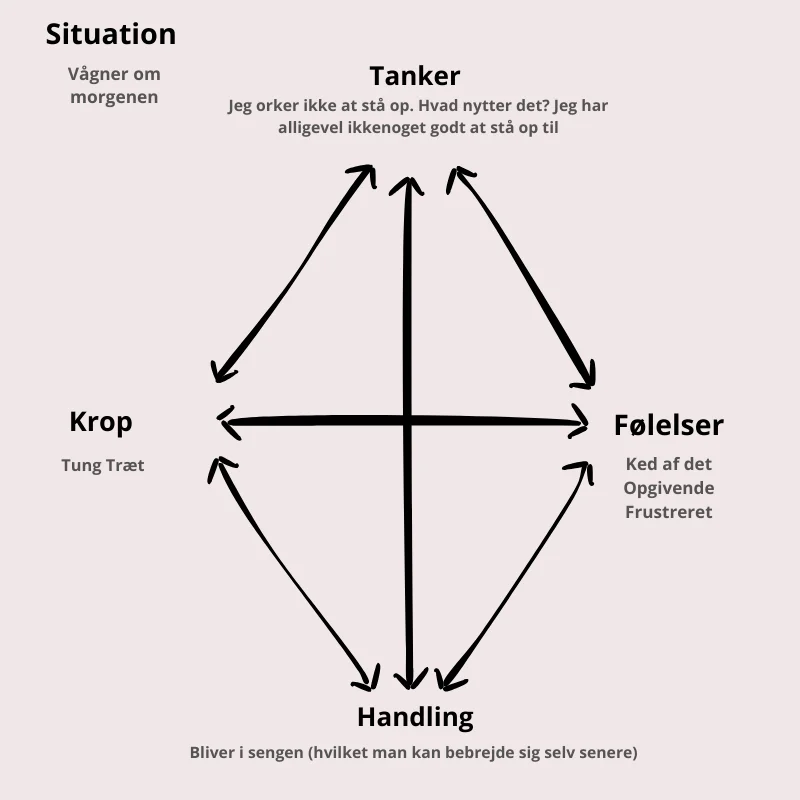
That thinking exhausts you, and one of its consequences is that it makes you passive. You do less, and that affects your feelings, and then the depression gets worse. That is the vicious circle that often takes hold when you have depression, and I show it in the two diamonds below.

Where cognitive therapy comes from

The psychiatrist Aaron T. Beck was originally trained in psychoanalysis, Sigmund Freud’s school of therapy. But when he researched the psychoanalytic theory of depression, he was surprised: the theory did not match what his studies of depressed patients showed. Psychoanalysis claimed that depression was caused by hostility turned against oneself and an innate need to suffer. Beck found instead that people with depression struggle with core beliefs about loss and failure.

His patients expressed many negative thoughts, and together with them he began to take a constructively critical look at the thoughts and assess their usefulness and validity. He found that the patients’ negative thinking in a situation affected their reaction more than the situation itself did. That was the start of the cognitive diamond and of cognitive therapy, which later became cognitive behavioural therapy.

Why cognitive therapy works for depression

Because you are affected both in your thinking and your behaviour when you have depression, cognitive therapy is a particularly well-suited form of therapy. It helps you recognise and change the negative thoughts and behaviour patterns that maintain your depression. But it also helps you understand why you have developed depression, and what you can do to avoid experiencing it again.

Treatment of depression is typically a combination of medication, such as antidepressants, and psychotherapy. Research shows, however, that medication only has an effect in moderate or severe depression. If you have mild depression, it therefore often makes no sense to start medication. You should always discuss that with your GP.

What else helps

The sessions are not the only thing that can help you out of your depression. Support from family and friends means a lot. So do regular exercise, a healthy diet and enough sleep. They are important parts both of the treatment and of preventing you from getting depression again. We talk about them along the way, at the pace you have the strength for.

The cognitive diamond in practice

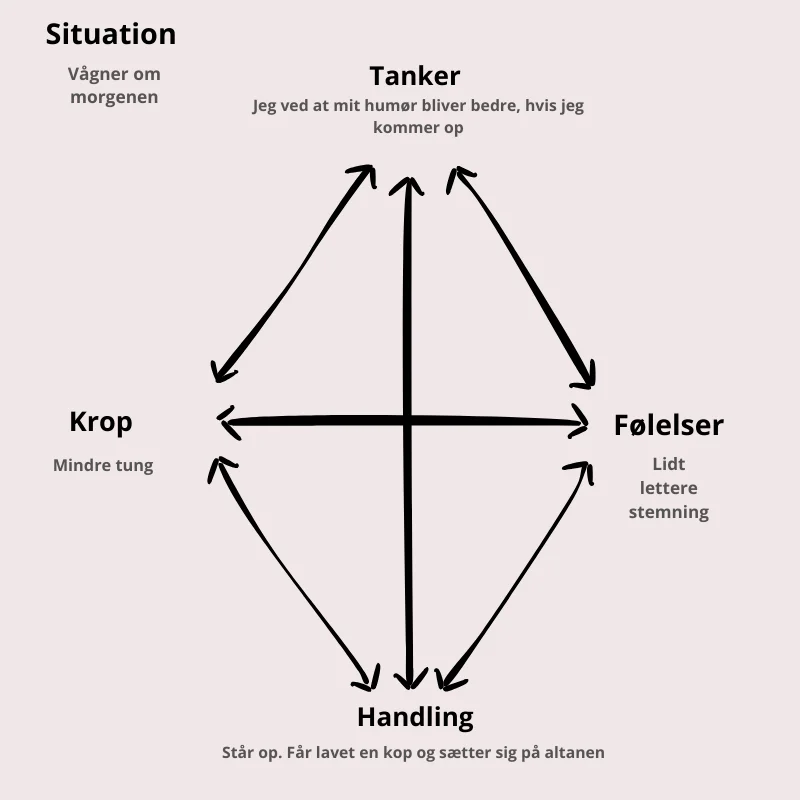
The cognitive diamond with depression: negative thoughts and passivity reinforce each otherThe cognitive diamond with realistic thoughts: more hope, energy and motivation

In the first diamond it is clear how the thought "it won’t help anyway" and staying in bed make you more and more sad and drained of energy, and that brings more negative thoughts and even more passivity. A downward spiral is under way, making you more and more depressed. In the second you see how more hope, more energy and more motivation come when you think more realistically and then get out of bed. That is the movement we make together, one small step at a time.

Evidence-based cognitive therapyfor stress, anxiety, OCD, depression and low self-esteem.

Come to the practice at AYA House or meet me online.

Danish-authorised psychologist · Specialist in adult psychotherapy19 years’ experience · You can use your health insurance and “danmark”

Typical course of depression treatment

– note that the number of sessions can vary depending on the problem.

  • Initial assessment & evaluation

    1–2 sessions

    When you come to see me, you may not have many words or much energy. That is perfectly all right. First of all I want to hear what made you get in touch, and what is affecting you right now. How does the depression feel to you, and what do you yourself think has led you here? Along the way I explain how I work with cognitive therapy and how I think we can approach your particular situation. Finally we agree on what to start with and what the goals of our sessions should be.

  • The treatment phase

    8–11 sessions

    Here we work with the depression itself, and with how it affects your thinking and your actions. On the level of thought, we take a constructively critical look at your depressive thoughts and at what they do to you. On the level of action, we try out new ways of acting in practice, small things that match the energy you have, so you slowly move out of your depression.

  • Final phase and relapse prevention

    1–2 sessions

    Finally we look at how you keep up the work on your depression and, if it has gone completely, what you can do to prevent it coming back. You now know your own early signs, and you know what to do when they appear.

I cannot say in advance how long your treatment will take. It depends on what you bring and how much you are able to work on it, both with me and between sessions. A typical course of treatment is 10–15 sessions in total, but it can be fewer or more.

The treatment in more detail

First we understand your depression

The cognitive treatment of depression is broadly about identifying, challenging and changing dysfunctional thoughts, beliefs and actions. When you start with me, we first get a picture of how your depression shows in your everyday life, in your thoughts and in your actions, and how it affects you.

Then comes psychoeducation, which is a fancy word for explaining the nature of depression to you: what happens in the brain, how it affects your patterns of thinking and acting, and how you can get stuck in a vicious circle that maintains the depression and perhaps makes it worse.

Then we look at your everyday life

Next, we look together in detail at your everyday life. What do you do, if you do anything? And what does it do to you: does it lift your mood, does it do nothing, or does it actually lower your mood? The aim is to fit as many activities into your everyday life as you can manage, activities that can lift your mood and your energy. Your brain has acquired a negative focus because of the depression, and it is our job, through action, to "force" it to discover that there are still good things in everyday life, tiny ones and big ones.

We also look at how you can get a little exercise in, what your sleep and daily rhythm are like, and whether you eat, and what. All those things play an important part in the treatment.

Then we work with thoughts and actions

Once your everyday life has structure and rhythm, we start on your thoughts and actions. We take a constructively critical view of the negative thoughts you have in different situations, and work together towards a more realistic view of the situations, of yourself and of others. We also look at whether your thinking is marked by cognitive distortions such as all-or-nothing thinking, overgeneralisation and catastrophising, because those reinforce the negative thinking.

At the same time we keep a constant eye on your actions, which are both governed by and govern your negative thinking. What do your actions do to your mood? Can a change in behaviour lift the mood and disprove the negative thoughts?

The puzzle that is you

In parallel we assemble "the puzzle that is you". We look at what may have caused you to end up in depression. Both external and internal factors play a part, and we work primarily with the internal ones, which also have consequences for the external. Among the internal factors it is often unhelpful rules for living and negative core beliefs that have played a part. Rules for living are the rules you have set up for how to relate to yourself, others and the world, and they are developed from what you fundamentally think about yourself and others. If the beliefs are negative, the rules become inflexible and counterproductive, because they are built on something that does not match reality.

Once the pieces are in place, we change what is unhelpful. That usually requires us to formulate new, more flexible rules for living and a more realistic core belief about yourself and others, and for you to begin living by them. It is an investment in the rest of your life, but also a tool here and now to get out of the depression.

The work between sessions

Finally we take stock of the tools you have gained, and which ones work for you, and we work on what you can do in future to prevent a new depression. Much of the treatment takes place in our collaboration, but there is also a great deal of work outside the therapy room, between sessions.

Now you may be thinking that you have no energy whatsoever for "homework" on your own. That is completely understandable, because you have depression, and then there is not much spare capacity, motivation or energy. So we plan very carefully what you should work on, according to how much energy and motivation you have. But the good thing is that the more you work between sessions, the closer you get to escaping the depression, and it becomes a positive snowball effect: good experiences give more energy and motivation, which give more good experiences. Cognitive therapy is a structured, goal-oriented form of treatment that makes you "your own psychologist", because you get a toolbox you can use for the rest of your life.

What is depression?

Depression is a serious mental disorder that affects your feelings, thoughts and behaviour. It is characterised by a deep feeling of sadness and hopelessness and by losing interest in and pleasure from what you used to love. It affects daily life and can cause a range of emotional and physical problems.

The symptoms vary in severity, but often include persistent sadness, apathy, tiredness, irritability, disturbed sleep, changed appetite, difficulty concentrating and feelings of worthlessness or guilt. In serious cases there can be thoughts of suicide or suicide attempts.

Depression is caused by a complex interplay of genetic, biological, environmental and psychological factors. Life events such as trauma, divorce, moving house, changing jobs, a new child or stress can trigger it. Biologically, changes in the brain’s chemical balance, especially the neurotransmitters serotonin and noradrenaline, can play a role.

You can have depression in different degrees, from mild to severe. It is a serious disorder that you should take seriously and get help for if you cannot manage it yourself. And that is rarely possible with moderate to severe depression. It can reduce your quality of life considerably and in some cases be downright disabling.

It is a good idea to start with your GP and talk about the symptoms you are experiencing. The doctor can screen for depression and guide you towards treatment. The symptoms must have lasted at least two weeks, but often they have been there longer. They can just be hard to notice yourself, and so it is often someone close to you who sees the depression before you do.

It is important to be alert to suicidal thoughts: whether you carry thoughts of not wanting to live any more and perhaps have made plans to take your own life. If that is how you feel, contact the nearest psychiatric emergency department immediately, or call 112. That also applies if you have not made plans but are worried that you might do something impulsive.

Who gets depression?

Depression can affect people of all ages and all backgrounds. It knows no social or cultural boundaries. Some groups are more vulnerable, though. Women are diagnosed with depression more often than men, probably because of an interplay of biological, hormonal and psychosocial factors. Hormonal changes with menstruation, pregnancy, childbirth and the menopause can play a part.

The risk is also greater if there is depression or other mental disorders in the family, which points to a genetic vulnerability. If you have experienced trauma, stressful life events, chronic illness or substance abuse, you are likewise more exposed. Young people can be particularly vulnerable because of pressure from social media, study pressure and the work of finding themselves, and older people because of loneliness, loss of people close to them and worries about health and independence.

And then there is what I want to say to you directly: depression can affect anyone, no matter how "ideal" life looks from the outside. It says nothing about who you are. It is a complex disorder that requires understanding and treatment that fits you specifically.


What forms of depression are there?

There are several forms of depression, each with its own features. Your experience is your own, and the diagnosis must be made by a professional, but it can help to know the forms.

Major depressive disorder (MDD)

One of the most common and serious forms: a persistent, intense sadness and loss of interest, together with sleep disturbances, changed appetite, tiredness, feelings of worthlessness and thoughts of death or suicide.

Persistent depressive disorder (dysthymia)

A milder but more chronic form. The symptoms last at least two years and include low mood, low energy and low self-esteem, among other things.

Bipolar disorder

Formerly called manic depression. Alternation between depressive and manic episodes. The depressive phases resemble MDD, while the manic ones bring abnormally high mood, increased energy and often risky behaviour.

Seasonal affective disorder (SAD)

Comes and goes with the seasons, most often in autumn and winter, easing in spring.

Postnatal depression

Can affect women after childbirth with strong sadness, anxiety and exhaustion, which make it hard to look after both themselves and the child.

Atypical depression

Differs in that the mood can briefly lift when something good happens.

Depression after psychedelic drugs

Some experience depressive symptoms after using hallucinogenic drugs such as LSD or psilocybin. It is less common.

The treatment depends on the form and is often a combination of therapy, possibly medication, lifestyle changes and support.

What reactions can you have to depression?

The reactions vary a great deal from person to person and depend on your personality, the type and severity of the depression and the support you have around you. But these are the reactions I see most often:

The feelings

  • Hopelessness and helplessness
  • Persistent sadness and crying
  • Irritability and frustration, even over small things
  • Guilt, worthlessness and self-criticism
  • Loss of interest in what used to bring joy, as well as anxiety and worry

The body

  • Insomnia or excessive sleep
  • Changed appetite and weight
  • Exhaustion and lack of energy
  • Unexplained pain and bodily symptoms

The thoughts

  • Difficulty concentrating and trouble making decisions
  • Negative or pessimistic thinking
  • Memory problems
  • Thoughts of death or suicide

The actions

  • Withdrawal from others
  • Decline in performance at work or in studies
  • Neglect of responsibilities and personal hygiene
  • Self-harm or abuse of alcohol and drugs as an escape

Relationships

  • Problems with family, friends and colleagues
  • Isolation and avoidance of social contact
  • Conflicts or increased sensitivity towards others

All of these are symptoms of a disorder, not character flaws. Early help, both professional and from those close to you, can be crucial to how quickly you get better.

Evidence-based cognitive therapyfor stress, anxiety, OCD, depression and low self-esteem.

Come to the practice at AYA House or meet me online.

Danish-authorised psychologist · Specialist in adult psychotherapy19 years’ experience · You can use your health insurance and “danmark”

What is life with depression like?

Life with depression is deeply challenging and affects almost all parts of your daily life. Your experience is your own, but there are features many recognise. You feel more or less constantly tired, hopeless and sad. You have lost interest in what you used to enjoy, and you may feel isolated and lonely. There is guilt, worthlessness and a lot of self-reproach.

Depression also affects the body: sleep plays up, appetite changes, and the tiredness becomes chronic. Some get headaches or muscle pain. Concentration and the ability to make decisions fail, memory gets worse, and it affects work, everyday tasks and relationships. Productivity falls, in studies, at work and with the practical things at home, and basic things such as personal hygiene and the home can be neglected, which in turn lowers self-esteem and reinforces the depression.

Many withdraw from friends, family and colleagues, and it becomes a vicious circle: when you isolate yourself, you feel lonelier, then you get sadder, and then you have neither the energy nor the desire to be social. At the same time the feelings become more intense and unpredictable. Small problems seem overwhelming, and the reactions to everyday pressures become stronger.

Life with depression is not only a struggle with the symptoms, but also with the misunderstandings and the stigma that still surround the disorder. But depression can be treated, and with the right support and treatment a great many people get their quality of life back. I have seen that again and again.

How does depression typically develop?

Depression typically develops through several phases, although the course varies from person to person. At first there are small changes in mood, energy and interest in daily life. They can be subtle: a feeling of tiredness, irritability or a slight sadness, and things begin to seem more overwhelming.

If the depression is not treated, the symptoms gradually become clearer and more persistent: more sadness, loss of interest in hobbies and company, sleep disturbances, changed appetite and more negative thinking. Gradually the depression disrupts daily functioning, work, studies, practical tasks and relationships, and it becomes harder to keep up normal productivity and to be with others. The body responds with pronounced tiredness, weight changes and unexplained pain, and concentration and decision-making are affected.

Without treatment the depression can become chronic, and that worsens quality of life considerably. In serious cases it can lead to suicidal thoughts or suicide attempts and to other disorders such as anxiety or substance abuse. So depression is a disorder that progresses, and early help plays a crucial role in stopping it. Therapy, possibly medication and changes in lifestyle can effectively improve both symptoms and quality of life.

What can I do myself if I have depression?

If you feel depressed, there are several things you can do yourself to support your recovery. The most important is to get a correct diagnosis and a treatment plan from a doctor or psychologist. That may be therapy, medication or a combination. Beyond that you can:

  • Build a support network. Share your feelings and thoughts with family, friends or a support group. Feeling understood makes a big difference.
  • Move. Physical activity improves mood and energy. It does not have to be hard training. A daily walk can be enough.
  • Look after your sleep and diet. A balanced diet and regular sleep are important for both body and mind.
  • Find calm. Meditation, yoga or deep breathing can reduce stress and bring a little more peace of mind.
  • Avoid alcohol and drugs. They worsen depressive symptoms.
  • Set small goals. Small, manageable goals that you actually reach strengthen self-esteem and give you a sense of mastery.

Remember that getting out of depression is a process. It is okay to seek help and to take time for yourself. Your health and your wellbeing are important.

What can I do if someone close to me has depression?

As a relative or friend you play a significant role in recovery. The most important thing is to show empathy and understanding: listen without judging, and show that you are there. Learn about depression, so you better understand what your loved one is going through and can offer the support that actually helps.

Support your loved one in seeking professional help, whether that is therapy, counselling or medical treatment. Be patient, because it takes time to come out of depression, and avoid pushing them to "get better quickly". Offer practical help: take on some of the daily tasks, go along to the doctor, or just be there as company. Encourage healthy habits such as exercise, proper food and sleep, preferably something you do together.

And look after yourself. Being close to someone with depression is emotionally demanding. Take care of your own mental and physical health, and seek help or support yourself if you feel the need. You help best when you have something to give.