OCD treatment

You know it makes no sense. Still, you cannot stop, and the rituals take up more and more of your life. It is not weak willpower, it is OCD, and it can be treated. At Den Kognitive Diamant I offer specialised treatment for OCD based on cognitive therapy and exposure and response prevention (ERP), an effective method for breaking OCD’s cycle of obsessive thoughts and rituals. Together we work with both thoughts and behaviour to reduce the anxiety and regain control in your everyday life. Treatment is adapted to your pace and your needs and can take place online or at my practice in Fredensborg.

Psychologist Therese Ejerskov
A client’s experienceAnne, 46

For most of my life I have had OCD. It got so bad that I could not work, and I had to have my son stay with my sister. Together with Therese I had an intensive course of treatment, where I was challenged on my OCD every time. I also got really good help to work with my OCD at home. Even though my OCD can haunt me a little when, for example, I feel stressed, I now live a life together with my son, and I feel free of my OCD. It is a huge relief. Therese is fantastic, and I am so glad I chose her as my psychologist.

About OCD and how we treat OCD together

What OCD is, and when it needs treatment

Obsessive-compulsive disorder, OCD, is a mental disorder with intrusive thoughts, obsessions, and repeated rituals or actions, compulsions. OCD comes in different degrees: mild, moderate and severe. We see mild OCD, for example, in children who go through a phase of playing that you must not step on the cracks, or that the teddy bears have to stand in a certain way. There is usually no assumption behind it that something dangerous will happen if they do not, and so it rarely develops into a disorder.

Moderate and severe OCD require treatment. Here it is important to seek professional help, because untreated OCD can be very disabling and restrict your life. With the right treatment, most people with OCD experience considerable relief. Psychotherapy and medication are often combined, but psychotherapy is as a rule the first choice, because it has been shown to have a more lasting effect than medication, and because it has no side effects.

We go against what your OCD tells you

Cognitive therapy is particularly good for OCD, because it works with both the thoughts and the behaviour. For the behavioural work I use a particularly effective technique, exposure and response prevention, ERP. With ERP we expose you, at your pace, to what triggers your OCD, and you practise not carrying out the rituals.

If your OCD tells you that you have to check the front door a certain number of times before you leave, or something bad will happen to you or your family, that is the thought. Not checking is the behaviour. You have to go against what your OCD says, because that is the only way to find out whether what it tells you is true. Now you may be thinking: "I could never do that." But you can, because before then we will have worked thoroughly on your particular catastrophic thoughts, that is, what your OCD says will happen if you do not do as it wants.

The cognitive diamond

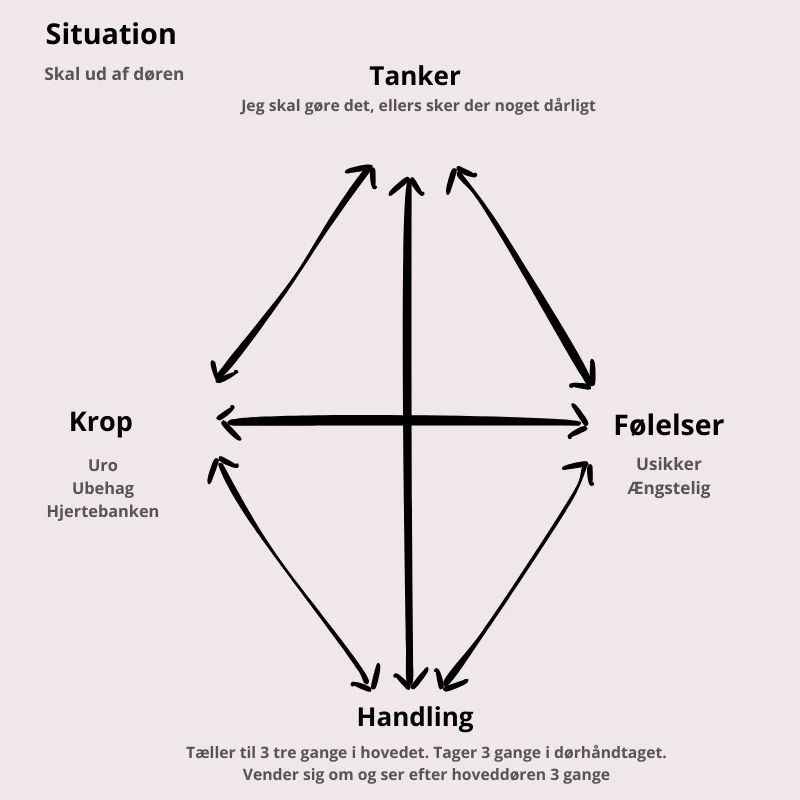
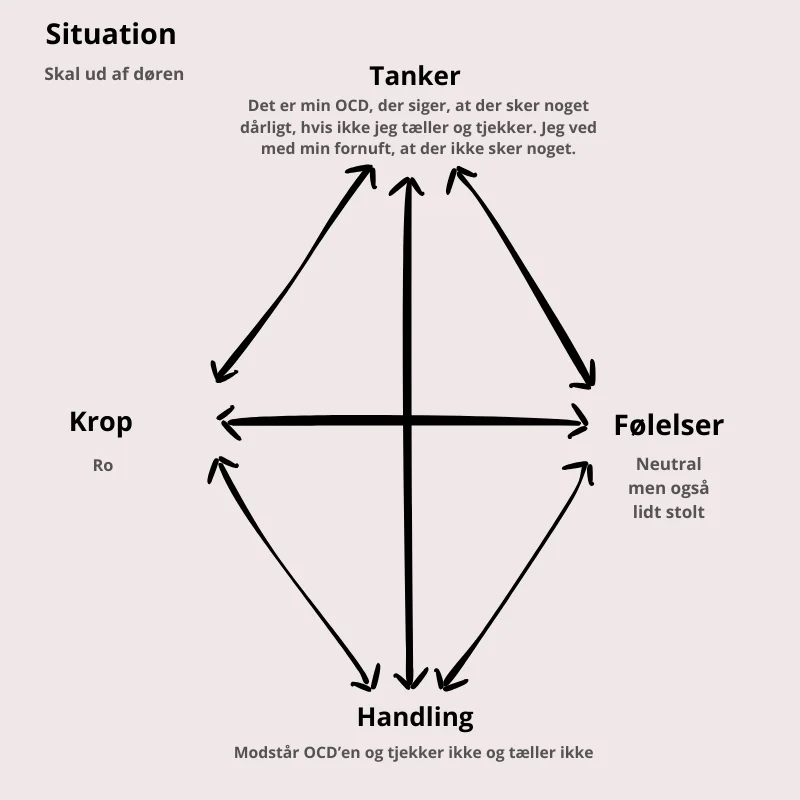
The cognitive approach to OCD is to work with the thoughts and the behaviour, on the premise that this affects the feelings, that is, the anxiety, and the bodily symptoms that come with it. It is one of the basic elements of cognitive therapy, the cognitive diamond: a model that shows how thoughts, feelings, behaviour and bodily sensations mutually affect and steer each other.

That is why it is a fantastic tool both for getting an overview of how your OCD affects you, and for working with it so that it disappears. Let me show you an example below.

The cognitive diamond in practice

The cognitive diamond with OCD: obsessive thoughts, anxiety and rituals reinforce each otherThe cognitive diamond with realistic thoughts: more calm in body and feelings

The two diamonds show how thoughts, feelings, behaviour and bodily sensations affect each other. In the first, the OCD is reinforced, because negative thoughts are at play, and you do as your OCD says. In the second there is more calm in body and feelings, because the thoughts have become more realistic and balanced. In the sessions we use the model on the situations where your OCD takes over.

Evidence-based cognitive therapyfor stress, anxiety, OCD, depression and low self-esteem.

Come to the practice at AYA House or meet me online.

Danish-authorised psychologist · Specialist in adult psychotherapy19 years’ experience · You can use your health insurance and “danmark”

Typical course of OCD treatment

– note that the number of sessions can vary depending on the problem.

  • Initial assessment & evaluation

    1–2 sessions

    When you come to see me, first of all I want to hear what made you get in touch, and what is affecting you right now. How do you experience your OCD, how does it trouble you in everyday life, and is there something you are afraid will happen if you do not listen to it? Many have never said the thoughts out loud before. Here you can, and I will not be shocked. I also explore what you yourself think led you to develop OCD, and along the way I explain how I work with cognitive therapy and how I think we can approach your particular OCD. Finally we agree on what to start with and what the goals of our sessions should be.

  • The treatment phase

    8–11 sessions

    Here we work with the OCD itself, and with how it is affected by your thinking and your actions. On the level of thought, we take a constructively critical look at your OCD thoughts: what do they say will happen, and how likely is it really? On the level of action, we try out new ways of acting in practice, and here the main thing is to go against your OCD. All at your pace. No one is thrown into something they are not ready for.

  • Final phase and relapse prevention

    1–2 sessions

    Finally we look at how you can keep up the work on your OCD, and if it is completely gone, what you can do to prevent it coming back. You now know its tricks, and you know what to do if it tries to sneak back in during a stressful period.

I cannot say in advance how long your treatment will take. It depends on what you bring and how much you are able to work on it, both with me and between sessions. A typical course of treatment is 10–15 sessions in total, but it can be fewer or more.

The treatment in more detail

First we understand what your OCD tells you

We start by getting clear about what your OCD says will happen, the obsessive thoughts, if you do not carry out your compulsions. Then we talk about thoughts in general. What are thoughts? How do you relate to yours? How much truth do you attribute to them?

Then we explore how much truth there is in your OCD assumptions. How realistic is it that the obsessive thoughts will become reality if you do not perform the ritual? Is there any connection at all between the catastrophic scenario and the compulsion? A cognitive understanding of what drives and maintains your OCD gives an overview and a clarity that makes it "easier" to begin challenging it. Rationally, you understand that there is not necessarily any connection.

Why reason is not enough

Perhaps you already understand this when you are not in a situation where your OCD is at play. But when you are in that situation, the anxiety still races through your body. That is because your rational understanding of the OCD sits in the frontal lobes, the part of the cerebrum that allows us to reflect and control our actions. Anxiety is an alarm signal controlled from the amygdala, the brain’s alarm centre.

The amygdala cannot tell the difference between real danger and your interpretation. In the very moment of anxiety, the connection between the frontal lobes and the amygdala is briefly cut off. The feelings have taken over, and that is why it is so hard to think rationally in the middle of it. For the frontal lobes to win over the amygdala, you have to feel with your body that there is no danger. The brain learns that through behaviour.

Then we challenge your OCD through action

So why not just start with the behaviour? Because working with your thinking is a necessary first step. If we do not know what the OCD tells us will happen, we do not know what to examine either, or why we should challenge the obsessive thoughts and the compulsions.

The next step is ERP, which you do both with me and on your own, in close collaboration. We talk thoroughly about how you can go against your OCD. In essence it is simple: you have to do the opposite of what it says, and then we examine whether what it tells you will happen actually happens. We call these behavioural experiments. You experience that your catastrophic scenarios do not become reality, and that there is no connection between the ritual and the imagined catastrophe. Gradually you feel, both cognitively and physically, that you do not need to carry out your compulsions.

Finally we make sure it lasts

When you have got this far, we look at what you can do to best prevent experiencing OCD again. It is quite possible to experience OCD, or the first stirrings of it, later on, for example if you are under pressure or very busy over a longer period.

But the good thing about cognitive therapy is that throughout your treatment you have gained tools to process and stop your OCD. You are equipped to get yourself out of it again. You will always have those tools, and they will always be able to help you.

What is OCD?

Obsessive-compulsive disorder, OCD, is a mental disorder with intrusive obsessions, obsessive thoughts, and compulsions, compulsive actions, which disturb daily life to a greater or lesser degree.

Obsessions are unwanted, repeated thoughts, images or urges that create anxiety. Some are afraid of contamination, that is, of being infected with something dangerous themselves or being to blame for others being infected. Others worry about harming others or are plagued by thoughts of being a paedophile. Even though you know the thoughts are irrational, they are hard to let go of and hard not to believe, because the idea of being to blame for harm to others is so extremely terrible for you.

That is no coincidence. Your obsessive thoughts are very often about what you think would be the worst imaginable thing to be to blame for or to have a tendency towards. What they are about is furthest from the person you are, and that is exactly what makes them so frightening.

Compulsions are ritual actions that you perform both to reduce the anxiety from the obsessions and to prevent them becoming reality. You wash your hands constantly or check the lock again and again. The actions give temporary relief, but they are never the solution. In the longer term they maintain and reinforce the anxiety. The causes of OCD are complex and involve both biological and environmental factors. Genetic predisposition, traumatic experiences and an insecure childhood are among the things that can contribute.

Who gets OCD?

OCD can affect people from all walks of life regardless of age, gender and background. The disorder often begins in childhood or adolescence, but it can arise at any age. Some studies point to genetics: if, for example, you have a parent with OCD, your risk is greater. My experience, though, is that the risk is at least as much about what that parent passes on and teaches the child through their actions.

The causes are not fully understood. Biologically, changes in the brain’s chemical balance, especially the neurotransmitter serotonin, may play a role, and researchers are also examining the brain’s structures to understand more.

The most important thing I can say to you is that OCD is not the result of weak willpower or an inability to "think positively". It is a serious, often disabling disorder. But with correct diagnosis and treatment, many achieve relief and return to a normal, well-functioning life.

What forms of OCD are there?

OCD is a complex disorder that shows itself in many ways, so two people with OCD can have very different symptoms. Here are some of the most common forms. Some have a combination of several, others only one.

Cleaning and washing rituals

Excessive washing and cleaning, because you are afraid of contamination from bacteria, viruses or dirt. You may wash your hands many times a day. The fear can be about being infected yourself or about being to blame for others being infected.

Checking rituals

You check again and again that the door is locked, the cooker off, the light off, the tap turned off. Behind this often lies an assumption that you must not be to blame for the house burning down because you forgot the iron.

Repetition rituals

You repeat a particular movement, sentence or action many times to prevent something bad from happening.

Need for order and symmetry

Things have to be placed in a certain way or be symmetrical. You become very uneasy, and can become anxious, if something is out of place.

Hoarding and collecting rituals

Fear of throwing something away in case you need it, which leads to excessive collecting of things. It is also called hoarding.

Mental rituals

You perform certain actions inside your head to ward off unwanted thoughts or events, for example counting to a certain number or saying a certain sentence to yourself.

Aggressive obsessions

Fear of harming yourself or others, even though you do not at all want to act on the thoughts.

Sexual and religious obsessions

Unwanted sexual thoughts or fear of acting against your religious beliefs.

Whatever the form, OCD can be disabling. But with the right treatment many achieve a marked improvement and go on to live a well-functioning life.

Evidence-based cognitive therapyfor stress, anxiety, OCD, depression and low self-esteem.

Come to the practice at AYA House or meet me online.

Danish-authorised psychologist · Specialist in adult psychotherapy19 years’ experience · You can use your health insurance and “danmark”

What reactions can you have to OCD?

OCD is first and foremost a mental disorder, but it also affects the body. Some reactions come directly from the compulsions: dry, cracked and irritated skin in those who constantly wash their hands or use sanitiser, sores and scratches from repeated scrubbing, and muscle soreness or strain injuries after hours of repeated movements. Others come from the persistent stress and anxiety that go with it: tiredness and exhaustion, both from the anxiety and from the many hours the rituals take, disturbed sleep, weight changes, stomach pain and digestive problems, tension headaches and in some people raised blood pressure. Not everyone experiences all of this. Talk to your doctor if you have physical symptoms that worry you.

There is a lot of anxiety connected with OCD, and so most people also experience the usual reactions to anxiety. Anxiety is felt in the body, but it is first and foremost a consequence of your thought, your interpretation. It is the thought that triggers the alarm in the amygdala, a small area in the brain’s temporal lobe, which sets the body up to fight, flee or freeze. The alarm system is vital; without it we could not survive. But the amygdala cannot tell the difference between real danger and your own interpretation of danger, and it reacts exactly the same to both. The interpretation and the alarm then set off a particular behaviour. This is what it typically looks like with OCD:

In your body

  • Pounding heart and unease in the body
  • Sweating, trembling and pressure on the chest
  • Breathing problems, nausea, dry mouth and trouble swallowing
  • Difficulty concentrating and sleep problems

In your thoughts

  • "If I don’t check, something terrible will happen to my mother."
  • "I have to count, or else … I have to wash my hands until it feels right."
  • "What if I could bring myself to stab him with the knife? If I have the thought, I might also do it."
  • "I have to confess, or else I am a bad person."
  • "I will never be normal. It will never go away. I am trapped."

In your actions

  • Counting, checking sockets, cooker, kettle, door, lock and windows
  • Performing rituals: washing hands, making the bed in a certain way, going in and out of the door in a certain way, reciting a phrase, blinking in a certain way, having a bedtime ritual every night
  • Avoiding children, places, adults, roads or things, avoiding certain words, and making sure not to have certain things in the kitchen drawer
  • Struggling not to think certain thoughts or see certain images in your mind
  • Asking again and again to have something confirmed or denied, and confessing everything to those close to you

What is life with OCD like?

Life with OCD can be deeply challenging. The constant stream of unwanted, intrusive thoughts and the urge to perform the rituals is draining, both physically and mentally, and so having OCD is also very stressful.

Many feel trapped by their own thoughts in a cycle of anxiety, rituals and brief relief. The rituals disrupt routines, work, study and relationships. Perhaps you spend hours checking whether the doors are locked, so you are not to blame for a burglary, or wash your hands again and again to prevent an infection you are afraid of.

On top of that comes constant self-monitoring. When you are constantly watching your own thoughts and actions, you become afraid of what others think, and then many withdraw from situations where the symptoms could become visible. And then there is the emotional burden: guilt, shame and frustration, especially when you know that the worries are irrational, but still cannot stop them.

Despite all that, many with OCD find relief with the right treatment, cognitive therapy and sometimes also medication. Support from family, friends or groups with others who have OCD can make a crucial difference. And in my sessions there is room to say everything out loud, including what feels impossible to say.


How does OCD typically develop?

OCD can start at any age, but for many it has been there since childhood or adolescence. The early symptoms can be so small that they are dismissed as ordinary childhood rituals or a phase. So there may be obsessive thoughts and compulsions in childhood that only flare up in adolescence or later in adult life, typically in a period when you are under more pressure than usual.

If the OCD is not treated, and you simply carry out the compulsions day after day, you never get to disprove the anxious thought that drives your OCD. So the thought is maintained, the OCD is maintained, and often it intensifies over time. What began as a single worry or a small ritual becomes more time-consuming and disruptive. At first you may have double-checked the door a couple of times; now you check it many times a day.

As the obsessive thoughts dominate more, you may start avoiding certain situations or things to keep the anxiety away, and that limits your activities and your time with others. With the awareness that your worries and rituals may not be "normal" come shame and guilt, and some isolate themselves. When the OCD finally interferes too much with life, many fortunately choose to seek help. It may be triggered by a particularly stressful period, by encouragement from those closest to you or by your own realisation of how much the OCD is in control.

Even with treatment the intensity can fluctuate, and some periods are worse than others, often with increased pressure, stress or major changes in life. But with the right treatment many learn to manage their obsessive thoughts and compulsions effectively. That is what we work towards.

What can I do for myself if I have OCD?

If you have symptoms of OCD, the most important thing is to seek professional help, preferably at the first signs, so you get the most effective treatment. But beyond that there are several things you can do yourself to tackle your OCD:

  • Get to know your OCD. The better you understand the disorder, the better equipped you are. Read books and articles, or join a support group where you can learn more and talk to others struggling with the same thing.
  • Hold on to an everyday life that is not run by OCD. Regular meals, sleep and exercise give a sense of normality.
  • Keep an eye on the pressure. Stress worsens OCD symptoms. What can you do to make your everyday life less pressured? Also cut down on alcohol and caffeine, which worsen anxiety and disturb sleep.
  • Challenge your thoughts. When an obsessive thought comes, you can ask: Is it realistic, does it match reality? Is it necessary, how important is it really? And is it productive, does it do anything constructive for you? That way you steer the thought instead of the other way round.
  • Keep going. Even when you are feeling better, and even when it is really hard. Continue the treatment, and keep challenging your OCD.
  • Share it with those close to you. When family and friends know what you are going through, they can also understand how best to support you.

And remember: it is not necessary to win an argument with every obsessive thought. Repeated analysis and reassurance can themselves become part of the rituals.

What can I do if someone close to me has OCD?

Being close to someone with OCD can be hard, but your support can play a crucial role. Start by learning what OCD is. Then it becomes easier to be empathetic, because you understand why the person does as he or she does, and you gain insight into how best to help. Show support, not condemnation. OCD is a real and often overwhelming disorder, and the person needs to feel that you are there to support, not to criticise.

Encourage professional help. Therapy, especially cognitive therapy, is very effective against OCD, and medication can help some. Be patient, because treatment can take time and have ups and downs. Celebrate the small victories, and be there through the setbacks. If the person is comfortable with it, it can be helpful for you to take part in a session or two to learn how to support best.

Set boundaries. It is important to support, but it is just as important not to become part of the rituals, neither by checking for the person nor by giving the reassurances the OCD asks for. Talk to a therapist about how best to help. And seek support for yourself, because living close to OCD is mentally draining. Consider a group for relatives or your own sessions. You cannot cure the other person’s OCD, but your understanding, patience and support can make a considerable difference.