Stress treatment

Stress is not a sign that you are weak. It is the body’s reaction to having been under strain for too long, and I know from 19 years as a psychologist how often it is the capable and responsible who are affected. At Den Kognitive Diamant I offer specialised stress treatment based on cognitive therapy. Together we identify and change the unhelpful patterns of thinking and behaving and the rules for living that have helped run you down. The treatment includes techniques to calm your nervous system and create balance between thoughts, feelings, body and behaviour, so you can regain your energy and perspective. Treatment can take place online or at my practice in Fredensborg.

Psychologist Therese Ejerskov
A client’s experienceMerete, 51

I never thought I would be “one of those” who went down with stress – after all, I could handle everything, and just had to get through the next week, which I told myself every week, until one morning I could not remember my husband’s name. When I came to Therese I was completely worn down by stress, but she got me back on my feet at a pace that was exactly right for me. My body does not forget my period of stress, but Therese has shown me how it is actually a gift – to have such a wise body that can send me signals when I push myself too hard. Because I still do at times, even though Therese has helped me see how the ideas I had about myself, and the rules and routines I had set up for myself, were helping to run me down. I have learned so much about myself, and today I have made some essential changes in my life and see myself from a different perspective, one that is much more who I am.

About stress and how we treat stress together

Stress affects every part of you

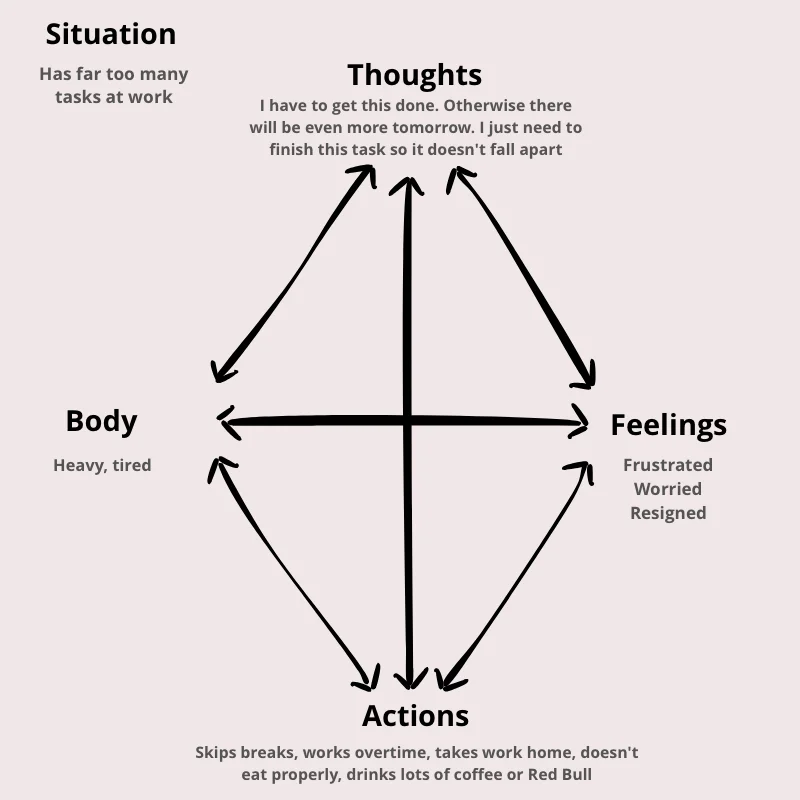
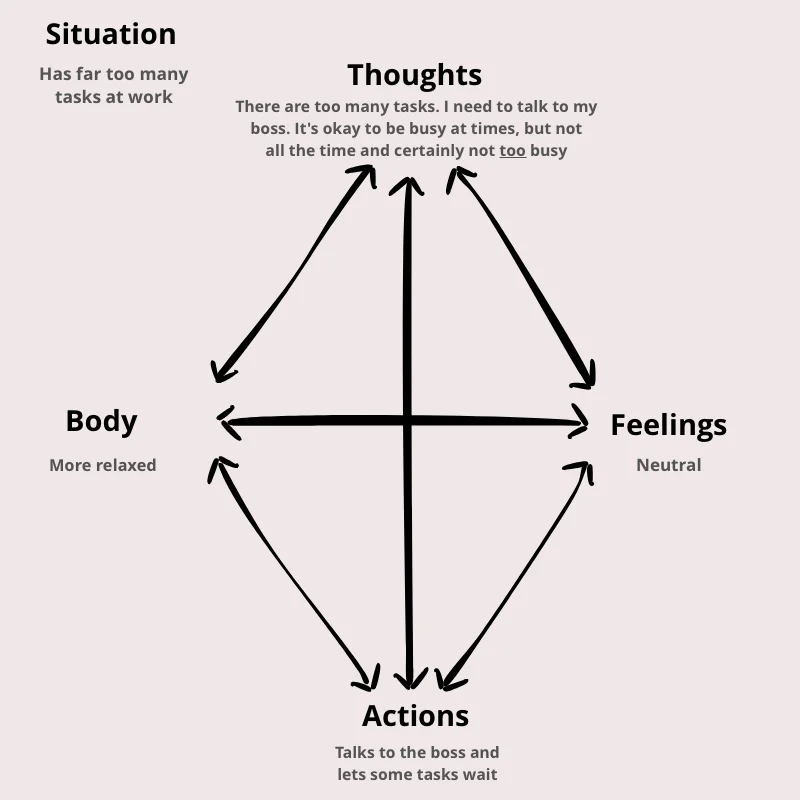
Stress is a physiological reaction to a strain that has lasted too long. It shows in all four corners of the cognitive diamond: in your thoughts, your feelings, your body and what you do. That is exactly why cognitive therapy is so well suited to stress. We work with all four corners and create balance between them, not only with what you think.

Over my 19 years as a psychologist I have formed a clear picture of what turns the body’s healthy state of alert into a strain that will not let go. We use that picture to understand what has happened to you.

What is weighing on you?

A great many people come to me with stress from work. Perhaps it is a boss who harasses or bullies, or who has neither the sympathy nor the empathy to understand the tasks you are expected to handle. Perhaps it is a workload that has grown after cutbacks and sick leave, or bullying from colleagues. I can rarely change your workplace from inside the therapy room, and I know that is what you would like.

What we can work with is how you handle the situation: both cognitively, meaning what you think about it, and behaviourally, meaning what you do in it. That applies whether the stress comes from work or from something in your private life, and this is where the change actually begins.

Rules for living lead to stress

In cognitive therapy we know that as children we form our core beliefs about ourselves and others. From them we make rules for how we must behave to be liked, capable and loved. We call them rules for living, and they quietly steer how you interpret your everyday life and what you do in it.

My experience is that very often it is those rules that have led you into stress: that you must always perform, always manage on your own, never let anyone down. We find your stress-provoking thoughts, the negative automatic thoughts, which are often exaggerated, unreasonable or simply incorrect. We challenge and revise them, so you perceive and react differently under pressure, and then we go after the rules for living behind them. The aim is that you do not end up in the same reaction again.

First, calming the body

Because stress is a bodily reaction, we begin by getting your nervous system to understand that there is no longer any reason to be working overtime. It is one of the first things we do, because it is hard to think clearly and work with your thoughts when the body is constantly on alert.

There are several good techniques for this, and we find the ones that suit you. Many notice the difference after the first few sessions.

The cognitive diamond in practice

The cognitive diamond with negative stress: thoughts, feelings, body and actions reinforce each otherThe cognitive diamond with realistic thoughts: more calm in body and feelings

Let me show you an example. The two diamonds show how thoughts, feelings, actions and bodily sensations affect each other. In the first, negative thoughts reinforce the stress that is already in your system. In the second there is more calm in body and feelings, because the thoughts have become motivating and realistic. In our sessions we apply the model to specific situations from your own week.

Evidence-based cognitive therapyfor stress, anxiety, OCD, depression and low self-esteem.

Come to the practice at AYA House or meet me online.

Danish-authorised psychologist · Specialist in adult psychotherapy19 years’ experience · You can use your health insurance and “danmark”

Typical course of stress treatment

– note that the number of sessions can vary depending on the problem.

  • Initial assessment & evaluation

    1–2 sessions

    When you come to see me, you may be tired, find it hard to gather your thoughts and not quite know where to begin. You do not need to. First of all I want to hear what made you get in touch, how the stress feels in your body and your everyday life, and what you yourself think has led you here. Along the way I explain how I work with cognitive therapy and how I think we can approach your particular situation. Finally we agree on what to start with and what the goal of the sessions should be.

  • The treatment phase

    8–11 sessions

    Here we work with the stress itself. First we calm your body, so you can think clearly again. Then we look at the role your thoughts and actions play in the reaction you have developed: the demands you make of yourself, what you say to yourself when you are under pressure, and the habits that keep you going even when you have nothing left to give. In your thinking, you learn to look at this in a constructively critical way. In what you do, we try out new ways of doing things, such as taking a break, asking for help or setting a boundary, both to bring calm to your body and mind now and to change what would otherwise lead you to the same place again.

  • Final phase and relapse prevention

    1–2 sessions

    Finally we look at how you hold on to what you have achieved when everyday life again demands something of you. We gather the tools that have worked for you and find your own early signs that the pressure is growing: the poor sleep, the short fuse, the break you skip. Then you can step in long before it becomes stress again.

I cannot say in advance how long your treatment will take. It depends on what you bring and how much you are able to work on it, both with me and between sessions. A typical course of treatment is 10–15 sessions in total, but it can be fewer or more.

The treatment in more detail

First we get an overview and create calm

We start by understanding your stress reaction as it looks right now: how it shows physically, mentally and in your behaviour. We also form an overview of the external factors that have helped put you under pressure.

When that picture makes sense to you, we set about reducing the body’s stress response. It may be getting your breathing deep down into your belly, which sends a signal to the brain that the nervous system can settle. It may be progressive muscle relaxation, where you tense a muscle and let go. Mindfulness meditation, yoga, running and walks in nature work for many. We choose whatever you are most comfortable with.

Then we examine your patterns

After that we look at the internal factors that have contributed to the stress. Often we have developed some distortions in the way we think about ourselves and others, and that is reflected in what we do. The distortions often come from unhelpful rules for living, which in turn come from our basic view of ourselves and others.

Here self-monitoring is a central part of the treatment. Between sessions you record and reflect on your thoughts and actions, for example in a diary of the situations that trigger stress and the feelings, thoughts and behaviour they set off. That gives us both a clear picture of your patterns and of what is tripping you up. We take a constructively critical view of the patterns, look at whether they fit the reality you are in, and change thinking and behaviour so that both work with you and not against you.

Finally we work with the rules behind them

Working with the patterns also shows which rules for living and core beliefs drive them, and that is the next step. The purpose is not only to get you out of the stress you have now, but also to prevent you ending up there again.

You get tools for handling periods of pressure, because there will be more of them in an ordinary life. The difference is that from now on you can notice them in time and know what to do, so they do not develop into stress that makes you ill.

What is stress?

Everyone experiences stress from time to time, and you probably do too. Stress is a natural physical reaction to demanding situations, and it is actually helpful when we face a challenge or a major demand. That is, if it is short-lived.

It was the researcher Hans Selye who formulated the original theory of stress. He showed that stress is the body’s reaction to any demand, psychological or physical, and the body’s way of defending itself against both internal and external demands. He divided the reaction into three phases, which he called the general adaptation syndrome: the alarm phase, where the body prepares to fight the strain, the resistance phase, where it fights to restore balance, and the exhaustion phase, where it gives up.

Biologically, stress releases adrenaline and cortisol, the two primary stress hormones. The pulse rises, blood pressure increases, breathing becomes faster and the senses sharpen. That helps you react quickly to a physical danger. But the strains most of us face today are not physical dangers as in prehistoric times. They are work pressure, finances that do not add up, or tensions in the family, and they rarely pass quickly. So the body’s quick reaction drags on, because the threat does not go away. In the end the fight-or-flight response is constantly switched on, and that is the chronic state of stress you may know right now.

Chronic stress can have serious consequences for health: an increased risk of heart disease, disturbed sleep, weight gain, digestive problems and a weakened immune system. It can also lead to depression and anxiety. That is why it is crucial to recognise the signs and act on them. And that is why it is good that you are here, looking into your options for help.

Who gets stressed?

Stress does not discriminate. Anyone can be affected, regardless of age, gender, background and social status, but the causes and the experience differ from person to person. Children and young people can be affected by school pressure, performance demands and problems with friends or at home. Adults are often affected by work pressure, responsibility for the family, finances or illness, and major events such as divorce, job loss or having a child can set it off. Older people can be affected when their health fails, or when they lose people close to them or their independence.

Life experiences also play a part. Refugees, war veterans and people who have been subjected to abuse can develop long-term stress or PTSD. And people living in poverty are under more strain, because food, housing and health are uncertain in everyday life.

Finally, your personality matters. If you have a perfectionist side and high expectations of yourself, you feel the pressure more strongly in situations where you have to perform. The people I meet in my practice are often the most responsible and conscientious. Stress says nothing about how strong or capable you are. It says something about how long you have carried too much.


What forms of stress are there?

Stress can be classified by cause, duration and the way it shows. The label rarely matters for what we do together, but it can help you recognise what you are facing.

  • Acute stress is the most common. It comes as an immediate reaction to a new challenge, an event or a threat. The symptoms can be physical, such as a rapid pulse and headache, or emotional, and they usually disappear again once the situation is over.
  • Episodic acute stress is when you experience acute stress again and again, often because you take on too many commitments, worry constantly or take a gloomy view of things. Over time it wears on both body and mind.
  • Chronic stress is the long-term stress that lasts for weeks, months or years. It typically comes from life situations that do not change: an unhappy marriage, a dysfunctional family or a work situation that is constantly too much. It can lead to heart disease, diabetes, depression and anxiety.
  • Traumatic stress can arise after a serious accident, a natural disaster, war, abuse or other life-threatening events. The symptoms can last a long time and include flashbacks, avoidance and heightened vigilance, and they can develop into PTSD.
  • Eustress is the positive stress you feel with good but challenging changes such as a new job, a move or a child. It can motivate you and improve your performance, but it is also a strain.

Stress can also be classified by where it comes from: work, family, finances or your relationships. Understanding the source and type of your stress is the first step to handling it and finding the right help.

What reactions can you have to stress?

When the body experiences stress, it switches on the fight-or-flight reaction, and you notice it physically, emotionally, in your thoughts and in your behaviour. Here are the reactions I most often hear about in my practice.

The body

  • Rapid pulse and faster breathing, because the body is preparing for action
  • Tense muscles and headaches
  • Stomach pain or digestive problems
  • Difficulty falling asleep, frequent waking and never feeling rested
  • Raised blood pressure and more infections, because the immune system is weakened

Thoughts and feelings

  • A short fuse, you get angry or frustrated more quickly
  • Anxiety, a constant feeling of worry, and thoughts going round in circles
  • Low mood, hopelessness and loss of interest in what you used to enjoy
  • Powerlessness and self-esteem that is slipping away
  • Difficulty concentrating, forgetfulness and trouble making decisions

Everyday life

  • Changed eating habits, both overeating and reduced appetite
  • Withdrawal from friends and from what you used to love
  • Restlessness, frequent switching of activity and a feeling of constantly being "on edge"
  • More alcohol, tobacco or other substances to be able to relax

You do not need to have all the signs, and your reaction depends on what is pressuring you, how long it has been going on, and who you are. Physical symptoms can also have causes other than stress, so talk to your doctor if you are worried.

What is life with stress like?

Life with stress can be overwhelming and draining. Everyday tasks and routines that you used to manage without thinking suddenly feel insurmountable, and it is hard to find joy in what you used to love.

The feeling of constantly being on guard makes it hard to sleep, and then you are tired but cannot relax. The tiredness and tension give you a short fuse, and it often affects those you love most. Some withdraw from the people around them, others react with anger or frustration over small things and feel bad about themselves afterwards.

In your head the worries go round in circles, and it feels as if the mind never gets any rest. Decisions become hard, concentration fails, and it affects both work and the ability to be present in what you are doing. The body responds with headaches, stomach pain and tension, and over time chronic stress can contribute to serious health problems such as heart disease, diabetes and a weakened immune system.

Leisure, hobbies and time with others, which you used to look forward to, become burdens. So you isolate yourself, get even less peace and time for yourself, and the stress grows. That is the vicious circle I help you out of. It can be broken, and most people notice that it begins to turn once the body settles.

Evidence-based cognitive therapyfor stress, anxiety, OCD, depression and low self-esteem.

Come to the practice at AYA House or meet me online.

Danish-authorised psychologist · Specialist in adult psychotherapy19 years’ experience · You can use your health insurance and “danmark”

How does stress typically develop?

Stress begins with a trigger. It may be overload at work, conflicts at home, financial problems or a major event such as divorce or bereavement. The brain assesses in a flash whether the situation is a threat, and if it is perceived as threatening or overwhelming, the body’s stress response switches on. Adrenaline and cortisol are released, the pulse rises, breathing becomes faster and the muscles tense. Your body is ready to fight what put it under pressure.

The problem is what we then do. The body is ready to remove the strain, so that calm and balance can return. But most of us react instead by working faster, withdrawing from our partner or arguing even more. We focus on the wrong thing, and the calm never comes. If it continues over a longer period, the body becomes exhausted. Then sleep and eating habits start to slip, and some reach for alcohol or other things to dampen the unease.

If the strain continues, or we fail to deal with it, the stress becomes chronic, and then the physical, emotional and mental symptoms follow. Untreated, it can contribute to heart disease, high blood pressure, diabetes, anxiety and depression. How fast it goes, and how hard it hits, varies a great deal from person to person. It depends on your genes, your earlier experiences, your personality and the support you have around you. In treatment we find out where the circle can be broken for you.

What can I do myself if I am stressed?

The first and most important thing is to understand, acknowledge and accept that you are stressed, and that gritting your teeth will not make it pass. Once you know what triggers your stress, you can begin to act on it instead of just putting up with it.

There is a good deal you can do yourself to help the body along:

  • Create an overview and set boundaries. Plan and prioritise your tasks, and learn to say no, so you do not overload yourself.
  • Get moving. Exercise is one of the most effective remedies for stress. It releases endorphins, the body’s own painkilling and mood-lifting substances.
  • Find calm. Try deep breathing, meditation, progressive muscle relaxation or yoga.
  • Look after your sleep and diet. Good sleep rebuilds the body’s and brain’s resources, and a balanced diet gives energy and a better mood. Cut down on caffeine, alcohol and sugar.
  • Talk to someone. Share your worries with someone you trust: a friend, a family member or a therapist. It eases the burden.
  • Give yourself time. Read a book, listen to music, be creative, or just relax without having to do anything.

Everyone experiences stress differently, and what works for one does not necessarily work for another. Choose a few changes at a time, and find the techniques that suit you. The work of getting better must not become yet another task you have to perform perfectly. And if you feel that the stress is out of control, or you notice signs of anxiety or depression, then seek help from a psychologist. That is what I am here for.

What can I do if someone close to me is stressed?

As a relative or friend you can make a big difference, and the most important thing is to show understanding and support without taking over. Listen actively without judging. Just knowing that someone hears and understands can be a great comfort. Avoid minimising the problem with phrases like "you shouldn’t feel like that" or "it’s not that bad". They can come across as condescending. Instead, say "I am here for you" or "how can I help?"

Practical help often counts for more than you think. Take on some of the household tasks, help with childcare, or just make a cup of tea. Encourage healthy habits by suggesting activities you can do together: walks, cooking, meditation or something else that brings calm. Learn about stress yourself from books, articles or courses for relatives, because the more you know, the better you can support them. And if you see signs of serious low mood, anxiety or other psychological difficulties, encourage them to seek professional help, and offer to help find a therapist.

Look after yourself too. Supporting a person with stress is emotionally draining, and you cannot rescue the other person. You can offer support, but you must set boundaries to protect your own wellbeing, take time for your own needs and seek support yourself if you need it. Being there for someone experiencing stress makes a big difference, but both the person with stress and you yourself need someone to lean on.