Strengthen your self-esteem

You can be good at your job and still carry a feeling that you are not good enough as a person. That feeling is not the truth about you. It is learned, and so it can be changed. At Den Kognitive Diamant I offer cognitive therapy to strengthen self-esteem. The treatment focuses on identifying and changing the negative core beliefs and rules for living, which often stem from childhood and which govern how you see yourself. Through treatment adapted to you, we work on building a more realistic and positive self-image, so you gain stronger, more balanced self-esteem. Therapy can take place online or at my practice in Fredensborg.

Psychologist Therese Ejerskov
A client’s experienceKaren, 36

I’m an expat in Denmark who sought help from Therese, initially because she speaks English. I felt it was safe for me to express myself freely and I’m very happy with the progress I made. The sessions changed my life in a positive way.

About self-esteem and how we strengthen your self-esteem together

We assemble the puzzle that is you

Cognitive therapy is a recognised method for strengthening damaged self-esteem. Broadly speaking it is about identifying and challenging the negative thought patterns and beliefs you have, for one reason or another, developed about yourself, others and the world, and replacing them with more realistic and positive perspectives.

In cognitive therapy we work from a cognitive conceptualisation of you. Figuratively speaking, we assemble, piece by piece, the puzzle that is you. The theory is that in childhood we form our core beliefs about ourselves and others. From them we develop rules for how we must behave to be liked and loved, and the rules affect the way we think, interpret and act in everyday life. My experience is that it is precisely those rules, the rules for living, that together with negative core beliefs about yourself are the reason you struggle with low self-esteem.

Self-esteem is not self-confidence

You can in fact have strong self-confidence and at the same time struggle with low self-esteem. Self-esteem is about your beliefs about your worth as a person: am I worth something, or am I not? If you fundamentally think that you are worth nothing, you quite naturally assume that others think so too, and that governs your behaviour and your interaction with others. Typical negative beliefs are "I am not good enough", "I am not worth loving", "I am wrong", "I don’t measure up", "I don’t fit in", "I am different".

Self-confidence, on the other hand, is about whether you trust that you are good at something, that is, about skills. You can think you are good at your job and at the same time struggle with low self-esteem that makes you assume your colleagues cannot be bothered with you or do not care about you.

The goal is a realistic view of yourself

The goal of your treatment is to reach a core belief about yourself in which you see yourself realistically. And over the many years I have worked with self-esteem problems, my experience has been clear: a realistic view is also a more positive view of yourself. I explain how we get there further down the page.

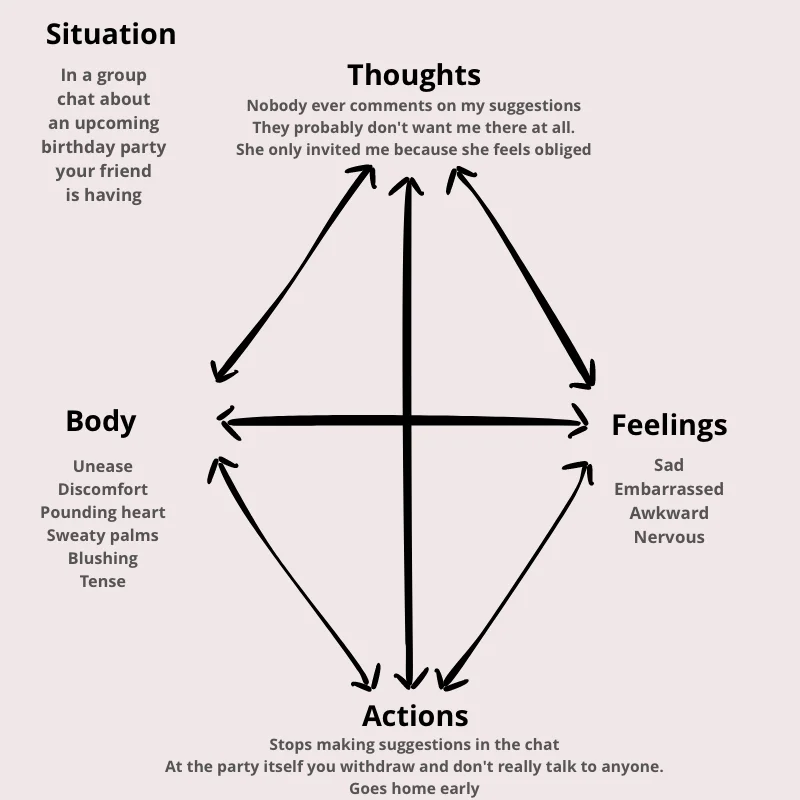
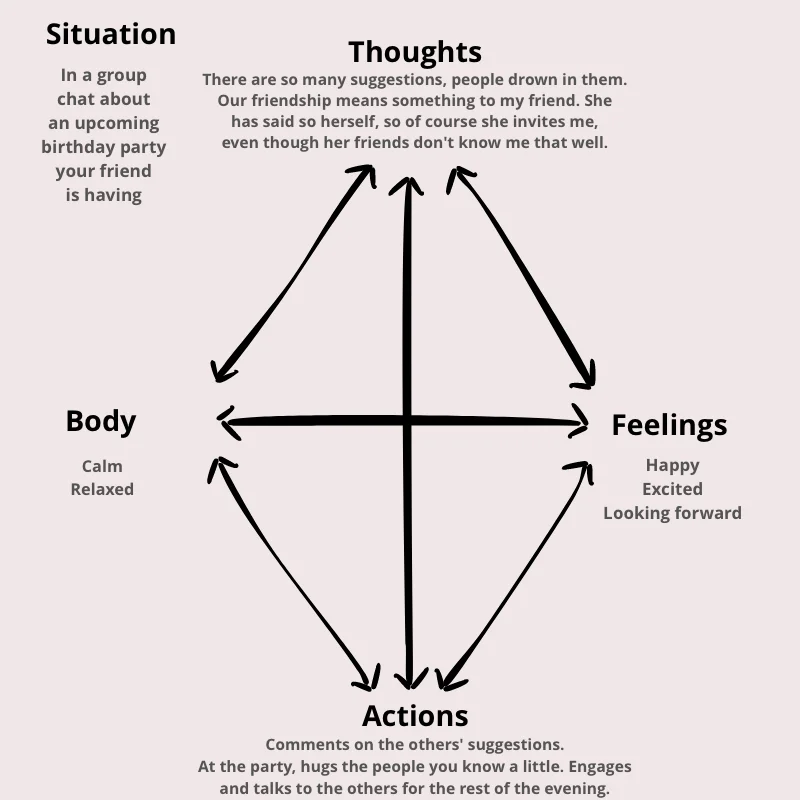
In all self-esteem problems, all four corners of the cognitive diamond are in play: thoughts, feelings, body and actions. Let me show you an example below.

The cognitive diamond in practice

The cognitive diamond with low self-esteem: negative thoughts about oneself reinforce self-criticism and withdrawalThe cognitive diamond with realistic thoughts: a calmer and more balanced view of oneself

The two diamonds show how thoughts, feelings, behaviour and bodily sensations affect each other. In the first, the negative thoughts about yourself reinforce each other and maintain the low self-esteem. In the second you get a calmer and more balanced view of yourself, because the thoughts have become positive and realistic, and that strengthens self-esteem. In the sessions we use the model on the situations where you are hardest on yourself.

Evidence-based cognitive therapyfor stress, anxiety, OCD, depression and low self-esteem.

Come to the practice at AYA House or meet me online.

Danish-authorised psychologist · Specialist in adult psychotherapy19 years’ experience · You can use your health insurance and “danmark”

Typical course for strengthening self-esteem

– note that the number of sessions can vary depending on the problem.

  • Initial assessment & evaluation

    1–2 sessions

    When you come to see me, first of all I want to hear what made you get in touch right now, and whether there is something that is especially hard for you at the moment. We talk about how you feel your low self-esteem affects you, and what it may stem from. There are probably things you cannot answer, and that is perfectly natural. We find the answers together. Along the way I explain how I work with cognitive therapy and how I think we can approach your particular situation. Finally we agree on what to start with and what the goals of our sessions should be.

  • The treatment phase

    8–11 sessions

    Here we work with the self-esteem itself, and with how it is affected by your thinking and your actions, but also the other way round: how your self-esteem affects your thoughts and actions. At the level of thought we take a constructively critical look at what you think about yourself and others. At the level of action we try out new ways of acting in practice, in the situations where you usually make yourself small. All to strengthen your belief in yourself and your worth.

  • Final phase and relapse prevention

    1–2 sessions

    Finally we look at how you keep up the work of strengthening your self-esteem, and what you can do to avoid falling back into the old rut that tells you that you are not good enough. You now know that rut, and you know how to climb out of it again.

I cannot say in advance how long your treatment will take. It depends on what you bring and how much you are able to work on it, both with me and between sessions. A typical course of treatment is 10–15 sessions in total, but it can be fewer or more.

The treatment in more detail

First we find out what is hard

My first step, together with you, is to find out what makes your everyday life difficult. We start from the diamond and look at which thoughts and actions govern you in the situations you experience as hard. That gives an overview of what is hard for you right now, and at the same time it gives us a picture of the rules for living and negative beliefs you have developed about yourself. So from the start we begin to assemble the pieces of your puzzle.

In my experience, and according to cognitive theory, your beliefs have roots all the way back in your childhood. That is where your beliefs about yourself and others are formed in an interplay between your innate temperament, what you have inherited from your parents, and the environment and experiences you grow up with. If you mainly have good experiences and are received and accepted as who you are, you form positive, healthy and realistic beliefs. If, on the other hand, you grow up in an environment that does not see you and your needs and does not accept you, you very probably develop mistaken beliefs about who you are and what others think of you.

Then we challenge the thoughts, with reason and with the body

Once we have a good picture of the negative thoughts and unhelpful actions that follow from your rules for living and core beliefs, we challenge them in two ways. Purely cognitively, using reason on the level of thought, we take a constructively critical look at your thinking in the difficult situations. Can the situation and you yourself be seen in a different way? What would happen if you thought differently? For some it is hard even with reason to see themselves in a more positive light, but for most it makes sense rationally.

Then we are ready for the next step: testing the new, more realistic thoughts through action. Our feelings find it hard to listen to reason. They need to experience first-hand that the negative beliefs are not true. So we set up behavioural experiments, where in your ordinary everyday life you test new thinking and new behaviour, and experience that your negative beliefs about yourself do not match reality. They were distorted in childhood on the basis of some mistaken conclusions about yourself.

Then we make new rules for living

When both feelings and reason begin to come into balance and believe that the old negative beliefs are not true, we make new, more helpful rules for living for you. Unhelpful rules for living can sound like: "I have to do everything perfectly." "I must never make mistakes." "If I don’t please others, they won’t want me." "If I think of myself, people won’t want me." "I have to manage everything on my own." "If I ask for help, I am weak."

Your rules for living did not come out of the blue. They were necessary once, perhaps they helped you survive physically and psychologically, and they made sense when you developed them as a child. But a child’s mind cannot put things in perspective or always understand what others think and why. A child who is bullied cannot see that Sofus and Amalie are bullying because they are struggling themselves. As children we take what we are told and shown at face value, and that is why mistaken beliefs arise so easily.

Finally you live by them

Once we have formulated rules for living that you believe in rationally, and that may also stir the feelings a little, they have to be tested, just as we tested the negative thoughts. You begin to live by them and have positive experiences showing that it is okay to fail, that people still like you, and that you can learn from it. Or that it is good to be able to manage on your own, but that you cannot always, and that people are genuinely glad to help and do not see you as weak.

The more you experience that the new rules are good for you and match reality, the more it opens the possibility that your core belief about yourself may not fit either. So we reformulate it, and that too is tested through your actions. You have to go out and experience that you are allowed to be you, exactly as you are, and that people like you when you are. When the evidence starts coming in, we are almost ready to finish, and you get an overview of your toolbox and what to be aware of in future. Not everyone needs a full course of treatment. If you have worked on yourself before, we may be able to move faster through some steps. That is all fine, as long as you get what you need.

What is a self-esteem problem?

A self-esteem problem is a persistent negative perception and assessment of yourself. It affects how you think about, feel about and act in relation to yourself and the world around you. It can show in many ways, but what is common is a deep-seated insecurity and doubt about yourself and your worth as a person.

Self-esteem problems often arise in childhood. Were you met with constant criticism? Did you only feel loved when you were praised for impressive achievements or did what mum and dad thought was right? Did you feel rejected and wrong because you had different interests from the others in your class, or did you compare yourself with others and never feel good enough? Such experiences shape your self-image. But later events such as break-ups, job loss, divorce or trauma can also contribute to low self-esteem.

The signs are constant self-criticism and focus on your own mistakes, excessive worry about what others think, fear of rejection that makes you avoid others, a feeling of inadequacy and inferiority, a tendency to exaggerate mistakes and play down successes, perfectionism and constant fear of failing, and physical discomfort from the constant stress and unease. It can affect everything from relationships and working life to your physical health. Fortunately it can be treated, through therapy, your own strategies and support from those you love.

Who can get problems with self-esteem?

Anyone, regardless of age, gender, background, culture and education. Self-esteem problems do not discriminate. Life events such as divorce, unemployment, trauma or even "minor" disappointments can create or worsen them. Children who grow up with a lot of criticism, bullying, physical or emotional abuse, or who feel overlooked and not accepted as who they are, can develop persistent self-esteem problems. In a world of social media, where everyone shows their best sides, constant comparison can give a feeling of never measuring up, and society’s expectations of appearance, behaviour and performance create a pressure that is not always possible to live up to.

Your innate temperament also plays a part, because it shapes how you handle what is hard: do you fight, or do you give up? If you are a fighter, you can develop a great need for control and perfectionist traits, and then you become very self-critical, because it is never good enough. If you give up, you never get to experience that you actually can cope with yourself and your challenges, and so you maintain the belief that you are not good enough. Hormonal changes in puberty, during pregnancy or in the menopause can affect mood and self-esteem, and so can chronic illness, disability and other health conditions.

The important thing is that self-esteem problems can arise for many reasons and affect anyone. Acknowledging the problem and seeking help are the first steps towards stronger self-esteem and more balance in your life.

What forms of self-esteem problems are there?

Self-esteem problems can be classified by where they come from, how they show, and how they affect your everyday life. Most people recognise themselves in several of the forms at once, and all of them very probably have roots in childhood.

Situational low self-esteem

A drop in self-esteem in reaction to a particular event: a failure at work, a broken relationship or another rejection. Self-esteem usually recovers when the situation improves, or with time.

Chronic low self-esteem

Persistently low self-esteem regardless of external circumstances, rooted in early experiences, deep-seated beliefs or long-lasting negative experiences.

Perfectionist self-esteem

Your self-esteem rests on your achievements. Any mistake, however small, is a blow, because you make unreasonably high demands of yourself. It is not a question of self-confidence, because it feels as if there is something wrong with you as a whole person, even with the smallest mistakes.

Comparative self-esteem

You constantly assess your worth in relation to others. If you cannot "measure up" to them, you feel you are worth nothing as a person.

Derived self-esteem

Your self-esteem depends on how others see you and react to you. When that outside validation does not come, you feel worthless.

Body-based low self-esteem

Negative perceptions of your appearance, influenced by media, society’s norms or your own experiences.

Understanding which form or forms you struggle with helps us target the treatment.

Evidence-based cognitive therapyfor stress, anxiety, OCD, depression and low self-esteem.

Come to the practice at AYA House or meet me online.

Danish-authorised psychologist · Specialist in adult psychotherapy19 years’ experience · You can use your health insurance and “danmark”

What reactions can you have to a self-esteem problem?

Low self-esteem shows in your feelings, your thoughts, your actions and your body. Here are the reactions I see most often:

The feelings

  • Shame and guilt
  • Chronic sadness or depression
  • Irritability and anger
  • Emptiness, resignation or meaninglessness
  • Inadequacy and inferiority

The thoughts

  • Self-critical thoughts and negative language about yourself
  • Black-and-white thinking with no middle ground
  • Focus on your own mistakes while successes are overlooked
  • Excessive worry about what others think or say about you
  • Difficulty making decisions for fear of failing

The actions

  • Avoiding social contact and situations where you may be judged
  • Self-sabotage: giving up projects early, not seeking new opportunities, or overuse of food, alcohol, drugs or gambling
  • Overcompensation through perfectionism or control
  • Withdrawing from friends and family
  • In severe cases self-harm or suicidal thoughts

The body

  • Insomnia or excessive sleep
  • Overeating or lack of appetite
  • Anxiety symptoms such as a pounding heart, sweating and trembling
  • Low energy and constant tiredness

Self-esteem problems are often linked to anxiety, depression, eating disorders and addiction. Seek professional help if you have persistent or serious symptoms.

What is life with low self-esteem like?

Life with low self-esteem is challenging and often painful, because self-esteem governs how you see yourself, your relationships and your place in the world. Your perception of yourself is negative and marked by self-reproach and self-criticism, and you often doubt your abilities, your worth and your importance.

That makes it hard to form and keep close relationships. You are afraid of rejection and criticism, hold back in social situations, avoid closeness or shy away from conflict. It becomes a vicious circle: you withdraw because you do not feel worth anything, so you get no close relationships, and that seems to confirm that you are worth nothing. Decisions become a struggle, because you are constantly afraid of failing or being judged, and so you become passive or far too dependent on other people’s opinions. Perhaps you set no goals for yourself at all or avoid anything where you can be judged, and that limits your opportunities. Or you become a perfectionist and chase unattainable standards to compensate for the insecurity inside.

The body pays too. Some neglect hygiene, food and exercise, and in some cases it leads to self-harm or substance abuse. Others do the opposite and become obsessed with appearance, over-train and eat extremely healthily to make up for the negative core belief about themselves. Chronic low self-esteem can precede or follow depression, anxiety, substance abuse and eating disorders, and even small everyday events, a minor mistake, can trigger overwhelming shame.

Life with low self-esteem is like carrying a heavy burden, where your own thoughts constantly undermine your wellbeing and joy in life. But it is possible, with the right support and therapy, to build healthier self-esteem and gain a completely different quality of life. I see it happen in my practice.


How does low self-esteem typically develop?

Low self-esteem develops over time in an interplay between internal and external factors. Self-esteem begins to take shape in the early childhood years, and negative experiences such as constant criticism, neglect, bullying or overprotection can plant the seeds. The child begins to believe that they are not valued, loved or capable. In the school years, self-esteem is affected by achievements, or the lack of them, in academic, sporting and social life, while comparison with peers and being left out or bullied lower the sense of worth further.

In adolescence, identity formation is central. Friends become more important than parents, the brain becomes more attuned to comparing oneself with others, and belonging to the group matters. Comparison (especially in the age of social media), body image, peer pressure and first relationships can complicate self-esteem, especially if you experience rejection, failure or criticism. As an adult, job loss, divorce or other personal setbacks can hit self-esteem hard.

Over time, individual negative experiences are reinforced through repeated patterns and self-fulfilling prophecies. If you believe you are unlovable, you may unconsciously sabotage your relationships, and then your perception is confirmed. To protect yourself from more pain you avoid challenging situations, but then you never get to experience that you can actually cope with them, and you do not develop the skills it takes. That undermines self-esteem even more. Low self-esteem can be both a cause and a result of depression, anxiety and eating disorders. But whenever it took root, cognitive therapy has good methods for strengthening it, so it becomes healthy and realistic.

What can I do myself if I have a self-esteem problem?

Working on your self-esteem takes time, patience and sustained effort. Self-esteem is not built overnight. But there are steps you can take right now:

  • See your strengths. Set aside time to reflect on your strengths, successes and good qualities, and write them down in a notebook.
  • Challenge the negative thoughts. When you notice a self-deprecating thought, stop and ask whether it is really true. Look at the situation more objectively, and replace the thought with a more balanced one.
  • Aim for "good enough". Instead of perfection. And celebrate the small victories along the way.
  • Set boundaries. Learn to say no. It gives a sense of control and strengthens self-esteem.
  • Look after yourself. Prioritise what makes you feel good: exercise, meditation, reading, hobbies or time with those you love. Try learning something new, it gives self-esteem a lift.
  • Drop the comparison. Comparison is the thief of joy. Focus on your own journey.
  • Talk to someone. Share your thoughts with friends or family. They often see you more clearly than you see yourself. And consider therapy, where cognitive behavioural therapy is particularly effective, because it works with both thoughts and behaviour.
  • Practise gratitude. Focusing on what you are grateful for can shift your perspective and strengthen the sense of worth.

Change takes time. But with sustained effort you begin to see changes in how you see and value yourself.

What can I do if someone close to me has a self-esteem problem?

Your support can make a considerable difference. Sometimes the person you care about just needs someone to talk to, and listening without judging is one of the most supportive things you can do. Be careful with criticism, because even well-meant criticism can be misunderstood and reinforce the self-criticism. Instead give honest and specific compliments that help the person see their own strengths. And never compare the person with others, certainly not disparagingly.

Encourage professional help, because a therapist can provide techniques and insight that are crucial. Be patient, because change takes time, and even when the self-perception begins to change, there will be setbacks. Be a stable support through the ups and downs, and encourage social contact, even in small ways, a walk or a hobby. Learn about self-esteem problems yourself, through books or courses, so you understand what your loved one is going through.

And set boundaries for how much you can give, so you protect your own wellbeing. Supporting someone can be draining, so consider a support group or sessions yourself. Remember that your love and support mean a lot, but that the change ultimately lies in the person’s own hands. Be there as a resource, not as the one who has to carry it all.